Olive Ripening: Between Yield and Quality
Share
Humanity has known the olive tree since before recorded history. Before the industrial revolution and the consumer society, subsistence farming was essentially the way in which almost the entirety of humankind experienced life and interacted with the world.
In this context, people's main concern was not their football team or the colour of the upholstery in their new car, but rather how to make it through the winter.
The Olive Tree: A Precious Plant
The olive tree is a truly important ally in this respect: this evergreen plant, resistant to disease and pests, produces fruit from which one can obtain this dense, oily liquid that is extremely rich in calories.
Lipids, in fact, make up almost the entirety of olive oil and contain a full 9 Kcal per gram, compared to the 4 of proteins and carbohydrates. What is more, oil retains its nutritional properties intact virtually forever in the way it used to be stored: our grandmothers kept it in the cellar, where it freezes in winter, and then went to retrieve it still solid with a ladle.
Oil as a Survival Resource
With this information, it is now easy for us to understand how, for thousands of years, the ability to obtain or produce oil was fundamental.
We know oil for its nutritional qualities, its health benefits and its unique flavour. But in the past these factors were secondary: the only thing that mattered was the quantity, the YIELD of the olives, whether the oil I had managed to produce this year would ensure my family's survival until the next season.
The Trade-off: Yield vs Quality
From this perspective, since the olive, in general and regardless of the cultivar, tends to increase the quantity of oil produced as it ripens, it was natural to try to push the harvest as far back as possible, even until January, in order to obtain the maximum possible yield.
This strategy has another effect, however: as the olive ripens, all the nutrient and antioxidant components, first and foremost the polyphenols, tend to deplete and disappear, sharply degrading the organoleptic properties and therefore the flavour of the oil.
A Mindset That Dies Hard
This mindset is in fact still very much present today. Almost all the customers of our mill, to whom we offer our pressing service, almost always ask us "what is the yield this year?" It seems that, when it comes to their own oil, no one wonders about the polyphenol content or the quality of the olives.
Extra Virgin Olive Oil Today
Extra virgin olive oil is no longer a basic subsistence foodstuff but has become the jewel of our pantry: we seek quality because we know its benefits and its ability to transform our dishes from a mere combination of ingredients into a symphony of flavours, where the oil, like an orchestra conductor, brings out the quality of each individual ingredient and accompanies them to our palate.
A New Trend: Early Harvesting
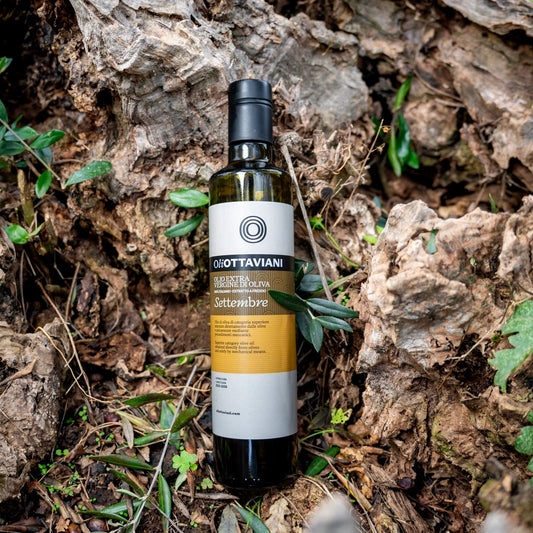
It is therefore understandable that today the tendency to delay the harvest is disappearing: indeed, the trend gaining ground today is the opposite one. An early harvest leads to a lower yield, but the quality of the oil is far higher.
📊 Table: Harvest Timing and Oil Quality
| Harvest Timing | Period | State of the Olives | Impact on Quality | Recommended Use |
|---|---|---|---|---|
| Early Harvest | September - October | Green or slightly purple | High polyphenol content, intense, bitter and pungent flavour | Dressings, tastings, luxury EVOO |
| Mid Harvest | November - December | Purple | Balanced taste, softer texture | Cooking, salads |
| Late Harvest | January - February | Black, fully ripe | Milder flavour, higher yield, fewer antioxidants | Everyday use, less prized |
Price and Availability: A Dilemma for the Consumer
It is easy to understand how, by the simple law of supply and demand, an oil produced at a lower yield with higher quality commands a higher price.
This can put the consumer in a difficult position: trying to obtain an early-production oil during the September-October period at a good price is not easy.
The price is high not only because of the high quality of the oil and its limited availability, but is also exacerbated by the period, which falls at a seasonal juncture when the supply of oil is at its absolute lowest, since the start of the new season inevitably coincides with the moment furthest from the last production season.
The Vision of Frantoio Ottaviani
We at Frantoio Ottaviani think differently. It is our intention to establish a lasting relationship of trust with our customers, allowing them to obtain it at a price agreed and locked in advance through our pre-orders.
Thank you for your attention and, if you are interested, do consider our offer of EVOO available for pre-order for the new season.
Sources
Ripening indices and harvesting times of different olive cultivars for continuous harvest
Ripening indices and harvesting times of different olive cultivars for continuous harvest
FAQ – Frequently Asked Questions
Why is early-harvested oil more expensive?
Because it has a lower yield but a higher quality. What is more, it is produced at a time when availability is at a minimum.
What are polyphenols and why are they important?
They are natural antioxidants that give the oil healthful properties and a robust taste. They decrease as the olive ripens.
When should I buy oil if I want the best quality?
Ideally between September and October, opting for oils obtained from an early harvest.
How does pre-ordering with Frantoio Ottaviani work?
It allows you to lock in an advantageous price in advance for the new season's oil, establishing a relationship of trust and continuity.